My goal as a movement and conditioning coach is to have the athlete perform better in his/her sport.
I think it is easy to solely focus on so called "strength and conditioning" that has it's own agenda with its own measurements and practices.
Ultimately everything I do with an athlete should reflect the actual sports performance. In other words, the movement conditioning should compliment the sport, filling in the gaps, strengthening certain aspects, reversing negative effects and so on....
Is it realistic to expect that effectiveness of the movement conditioning could be measured by improvements in the actual technique of the sport specific movement?
I think so. I believe that the results of movement conditioning should be seen as a better ability to absorb techniques and sport specific skills.
This does not mean that I should necessarily imitate the movements of the sport performance. It simply means that I should facilitate an adaptational absorption layer where new motor stimulations can "stick" and cause a learning response to occur.
When you build a new addition to a house, you must be sure that the original foundation at the ground level is solid but you must also prepare a new "foundation" layer in order to put something on top of the original structure..... I hope I am right about this...I know nothing about building houses....
However, you do know about the guy who built his house on the sand right?
Have an excellent week!
Tommi
PS: Man must evolve for all human conflict a method which rejects revenge, aggression and retaliation. The foundation of such a method is love. Martin Luther King Jr.
Monday, April 7, 2008
Tuesday, March 11, 2008
What does "Athletic Development" look like?
It is interesting to discuss what 'athletic development' means to each person and what do they think a workout program with such an objective would look like?
By 'athletic development' we generally speaking talk about performance enhancement by means of different exercises.
A lot of people would say that an 'athletic development' program has a lot of power elements, speed and agility, strength exercises, plyometrics, sprints, metabolic conditioning and so forth...
What do YOU see when you picture the main exercises for 'athletic development' in your head?
-------------
It is pretty interesting that day after day in the trenches of training all sorts of people with all sorts of objectives, one component of human movement rises up from among the others...
So when do I see the most acute responses and positive adaptations in terms of athletic development?
And what kind of drills or exercises elicit the best visible response?
Sometimes the answer comes to me as a surprise....the exercise that elicits the best response might not look or smell much like power, plyometrics or lactic acid...but it looks and smells something else and that is PROPRIOCEPTION.
Proprioceptive activation and recruitment of the desired chain in the body within an active warm-up or movement preparation has probably been the most valuable training tool I have learned about.
Movements that wake up the glute complex can be immediately seen in the vertical jump or in single leg balance.
Movements that actively engage the SSC of the ankle complex can be seen right away as improved foot contacts in the sprint or in the ladder.
Movements that reflexively acticate the stabilizers of the trunk result in better coordination and agility and power.
So, back to the beginning.
Most of the movements that do all these things do NOT look like 'athletic development' at all but could potentially change the outcome of all the other exercises performed during the session...
It is all about creating an optimal adaptation...and I can't do that without appreciating PROPRIOCEPTION.
It is a fascianating thing....can't really see it...can't really point out where it is...can't really tell exactly what it is.....can't even say how it truly works....but it is there and it is important.
Have a victorious day!
Tommi
PS: The positive thinker sees the invisible, feels the intangible, and achieves the impossible. Anonymous.
By 'athletic development' we generally speaking talk about performance enhancement by means of different exercises.
A lot of people would say that an 'athletic development' program has a lot of power elements, speed and agility, strength exercises, plyometrics, sprints, metabolic conditioning and so forth...
What do YOU see when you picture the main exercises for 'athletic development' in your head?
-------------
It is pretty interesting that day after day in the trenches of training all sorts of people with all sorts of objectives, one component of human movement rises up from among the others...
So when do I see the most acute responses and positive adaptations in terms of athletic development?
And what kind of drills or exercises elicit the best visible response?
Sometimes the answer comes to me as a surprise....the exercise that elicits the best response might not look or smell much like power, plyometrics or lactic acid...but it looks and smells something else and that is PROPRIOCEPTION.
Proprioceptive activation and recruitment of the desired chain in the body within an active warm-up or movement preparation has probably been the most valuable training tool I have learned about.
Movements that wake up the glute complex can be immediately seen in the vertical jump or in single leg balance.
Movements that actively engage the SSC of the ankle complex can be seen right away as improved foot contacts in the sprint or in the ladder.
Movements that reflexively acticate the stabilizers of the trunk result in better coordination and agility and power.
So, back to the beginning.
Most of the movements that do all these things do NOT look like 'athletic development' at all but could potentially change the outcome of all the other exercises performed during the session...
It is all about creating an optimal adaptation...and I can't do that without appreciating PROPRIOCEPTION.
It is a fascianating thing....can't really see it...can't really point out where it is...can't really tell exactly what it is.....can't even say how it truly works....but it is there and it is important.
Have a victorious day!
Tommi
PS: The positive thinker sees the invisible, feels the intangible, and achieves the impossible. Anonymous.

Monday, February 25, 2008
Conditioning for Outdoor Sports
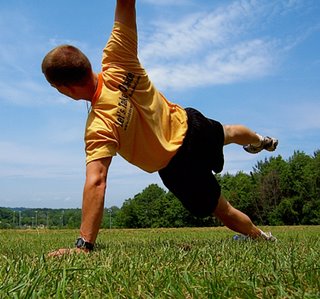 Is climbing the best conditioning for climbing?
 Does a kayaker need to strength train?
What can I do to get prepared for my hiking trip?
Outdoor sports have certainly made it to the map. Despite the extreme classification of some of these sports, you could hardly call them marginal sports anymore. Apart from activities such as base jumping or deep sea diving, outdoor sports are gaining wider popularity and almost becoming mainstream.
As these extreme sports grow, so does the knowledge of how to become better at them. Paddle sports, rock climbing, and hiking are all wonderful activities and can be enjoyed even more by engaging in the proper conditioning.
Questions are often raised on the importance of conditioning for these sports as they are becoming more popular at all levels. One could think that as the extreme sports are often intense and total by nature, add-on conditioning would not be necessary. Now, you cannot get around the fact that the sport itself will not prepare you best for the sport. You cannot become a kayaker by lifting dumbbells, just like you cannot become a climber by doing push-ups. The connection between specific movement patterns and body’s ability to perform can only be produced in the particular movements of the sport itself. Only the sport itself trains the body in right ratio of different motor components. For example; rock climbing involves strength, balance, coordination, flexibility, endurance and power in a specific formula that can only be reached by climbing. However, the human body seems to require a diverse combination of stimulations to become an optimally performing specimen and that is where conditioning comes into the picture. This is supported by the fact that every single successful athlete dedicates a considerable amount of time and effort into programmed sport conditioning.
The focus here is on conditioning that is not performed within the sport activity itself, supplemental conditioning, if you will. As examples of conditioning within the sport, kayakers can condition themselves by paddling sprints of various durations, intensities and recoveries; climbers can perform reactive “dyno” training repeatedly for power and lock-out strength; hikers can focus on the performance specificity by carrying different loads with different speeds.
Supplemental conditioning consists of exercises that are designed to assist in following areas:
- Enhancing the strengths and weeding out the weaknesses of the performance.
- Optimizing body’s overall movement ability and performance capacity in order to enhance adaptation through sport specific training.
- Preventing injuries that might be caused by repetitive movement patterns.
Got chalk?
Tommi
PS: If human beings are perceived as potentials rather than problems, as possessing strengths instead of weaknesses, as unlimited rather that dull and unresponsive, then they thrive and grow to their capabilities. Bob Conklin
Monday, February 11, 2008
Functional confusion?
So what is the best way to train?
- pilates?
- strongman training?
- stretching?
- spinning?
- functional training?
Is there something wrong with the question?
I guess we can mostly blame ourselves as professionals in the field for the fact that confusion over which "training style" is the best, is evident at the moment.
The whole premise of calling functional training a style of training is misleading, I think. We have started to define functional training based on the exercise equipment that we use instead of focusing on the the whole concept of function. "If you use a bosu or a medicine ball or a resistance band it is definitely functional, right?" I am not sure if it is that simple.
"Functional" is not defined by the equipment or by the exercise - it is more or less defined by its effectiveness in enhancing human movement. It may be enhancing everyday life, improving sport performance or correcting poor movement patterns. All of that can be "functional" regardless of which equipment you use.
I have a question that I am pondering myself. Maybe you already have an answer to this...?
If an exercise is very effective in terms of the goal it is designed to reach, is it safe to call it "functional?"
In other words, If I know the goal of my client and I choose an approach that will be very effective getting him/her there....have I already fulfilled the requirements of "functional training?"
What do you think?
So, what if my client's goal is to grow his left biceps as big as possible? A very specific and admirable goal indeed....I can definitely design a program that is pretty effective in terms of his goal (or hers...) but will it enhance human movement as a whole?
(a stupid example. Sorry, it is Monday.)
Then on the other hand, it could be defined as training for human movement - training for this goal does require movement after all.
What if I train a powerlifter that focuses on bench press? Is bench press as an exercise functional for him (or her, I apologize for the discrimination in my examples, let's call this guy Mike from now on to avoid more confusion..) If bench press is functional for Mike, is it functional for everyone?
What if the bench press enhances the bench press but causes limitations within other dimensions of human movement? What if Mike's gait gets distorted or the mobility of his upper back decreases as a result of bench press? Is it functional now?
What if Mike performs a lot of exercises that also enhance his proprioception, balance, mobility and stability to compliment his bench press?
Or what about Linda whose work consists of squeezing a phone between her shoulder and head while typing an email seated on an office chair that is set too low for her?
What would her functional training program look like?
________
How can we examine this "mystery" of function and functional training?
Could we use some "functional filters" to get closer to an answer?
My thought process today is that in order for an exercise to be functional is has to go through three "functional filters."
Functional filter no.1: "Function is determined by the structure of the human being."
Functional filter no.2: "Function refers to an objective of the training, not the method."
Functional filter no.3: "Function is defined by the needs and characteristics of each individual."
Hmmmmm.....I start to find loopholes in my theory already as I am writing.....
Would these filters even work?
Or would we need them in the first place?
What is the function of this blog entry anyway?
How did I get so confused?
....Anything for a headache, anyone?
Tommi
PS: If confusion is the first step to knowledge, I must be a genius. Larry Leisner
- pilates?
- strongman training?
- stretching?
- spinning?
- functional training?
Is there something wrong with the question?
I guess we can mostly blame ourselves as professionals in the field for the fact that confusion over which "training style" is the best, is evident at the moment.
The whole premise of calling functional training a style of training is misleading, I think. We have started to define functional training based on the exercise equipment that we use instead of focusing on the the whole concept of function. "If you use a bosu or a medicine ball or a resistance band it is definitely functional, right?" I am not sure if it is that simple.
"Functional" is not defined by the equipment or by the exercise - it is more or less defined by its effectiveness in enhancing human movement. It may be enhancing everyday life, improving sport performance or correcting poor movement patterns. All of that can be "functional" regardless of which equipment you use.
I have a question that I am pondering myself. Maybe you already have an answer to this...?
If an exercise is very effective in terms of the goal it is designed to reach, is it safe to call it "functional?"
In other words, If I know the goal of my client and I choose an approach that will be very effective getting him/her there....have I already fulfilled the requirements of "functional training?"
What do you think?
So, what if my client's goal is to grow his left biceps as big as possible? A very specific and admirable goal indeed....I can definitely design a program that is pretty effective in terms of his goal (or hers...) but will it enhance human movement as a whole?
(a stupid example. Sorry, it is Monday.)
Then on the other hand, it could be defined as training for human movement - training for this goal does require movement after all.
What if I train a powerlifter that focuses on bench press? Is bench press as an exercise functional for him (or her, I apologize for the discrimination in my examples, let's call this guy Mike from now on to avoid more confusion..) If bench press is functional for Mike, is it functional for everyone?
What if the bench press enhances the bench press but causes limitations within other dimensions of human movement? What if Mike's gait gets distorted or the mobility of his upper back decreases as a result of bench press? Is it functional now?
What if Mike performs a lot of exercises that also enhance his proprioception, balance, mobility and stability to compliment his bench press?
Or what about Linda whose work consists of squeezing a phone between her shoulder and head while typing an email seated on an office chair that is set too low for her?
What would her functional training program look like?
________
How can we examine this "mystery" of function and functional training?
Could we use some "functional filters" to get closer to an answer?
My thought process today is that in order for an exercise to be functional is has to go through three "functional filters."
Functional filter no.1: "Function is determined by the structure of the human being."
Functional filter no.2: "Function refers to an objective of the training, not the method."
Functional filter no.3: "Function is defined by the needs and characteristics of each individual."
Hmmmmm.....I start to find loopholes in my theory already as I am writing.....
Would these filters even work?
Or would we need them in the first place?
What is the function of this blog entry anyway?
How did I get so confused?
....Anything for a headache, anyone?
Tommi
PS: If confusion is the first step to knowledge, I must be a genius. Larry Leisner
Monday, January 21, 2008
Your Strategy - Saturation or Optimization?
 Which one of these following strategies do you think is utilized more in modern coaching and conditioning?
1. Saturation
This is just a term that I use to describe the way of training that is, intended to prepare the athlete for the game/race/competition so that nothing that the athlete will face during the competition will exceed what the athlete has gone through in his/her training.
In other words, especially in terms of volume, the athlete trains so much that a single race or a series of races will not be a problem what it comes to the level of traditional conditioning.
In my opinion, saturation strategy is used particularly by endurance athletes that want to make sure that they have enough miles behind them on the road or in the pool before the competition.
The off-season is usually the time when this kind of training takes place the most.
2. Optimization
This is not the best term here as it easily suggests that this is the only correct strategy because of the word "optimization". Who wouldn't use the most "optimal strategy"? Well, that is not the thing, I just haven't come up with a better term yet.
Optimization refers to a way of preparing for the race or races that aims to a least possible amount or volume of training and conditioning in order to reach the desired goals.
Again, a better explanation could be that the athlete tries to train as little as possible in order to get to a desired level of fitness for a specific race or season. It might still be a lot of overall volume but not a single "wasted" mile or minute.
This is where the word "optimization" comes in. Every minute and hour would have to be optimized in training to get to the same (or better) level than the athletes who "saturate" themselves.
_____________________
Is there a point to this discussion? Does any athlete use just either or of these strategies? What are the pros and cons of these different ways to prepare for a "battle"?
Saturation-strategy is probably safer in terms of consistent level of fitness and conditioning throughout then season. However, the high volume of training always poses a threat to recovery and thus is potentially more injury-prone approach. Saturation can take the athletes that can tolerate a lot of volume to a high level, but can at the same time drop out promising athletes whose adaptational ability is different.
This brings up an interesting question. Are endurance sports on top level only for those who can handle a lot of volume in training or could someone with less ability to recover do well with a different strategy?
Or is there a point in athletes life where saturation phase has lasted for a decade or two and now a different strategy would work better?
What about reaching the full potential of an athlete? I could be wrong but my guess is that by using saturation strategy solely athlete's potential can never be fully reached...not that it ever will completely, but at least in terms of realistic potential.
If we look at the optimization strategy, we find some holes in this theory as well. It is possibly much more uncertain approach in reaching the goals...a lot of things could go wrong. Not training enough could obviously ruin the whole season.
This approach would also require a lot of skill, eye and experience from the coach and the athlete to be able to successfully put the plan in action and stick to it.
Great thing about optimization would be the time allocated for the adaptations to take place, just as long as there would be something to adapt to. Without sufficient training stimulation there is obviously no adaptation.
With optimization, small everyday tweaks and tools such as active warm-ups, recovery strategies, heart rate monitoring etc. would become essential.
So which strategy is better?
I don't believe there is an answer to that question. It all depends on the individual, right? What a boring answer, huh? How about a combination of both? That is what I am using for my athletes now...enough volume but not a single mile trained without a clear goal and adaptation in mind for those miles...so no "wasted" miles.
I am fascinated by the training methods by one of the all-time best runners ever, a 9-time olympic winner Paavo Nurmi (1897-1973).
He trained volume like a maniac but also included advanced recovery and optimization staregies in his training. He walked and hiked a LOT and measured his level of fitness with 400 m sprints.
He performed active warm-ups and flexibility programs on his own and planned his training like a war general.
There is a lot to learn from the mentors of the past.
Tommi
PS: Too many people confine their exercise to jumping to conclusions, running up bills, stretching the truth, bending over backward, lying down on the job, sidestepping responsibility and pushing their luck. Author Unknown
Wednesday, December 12, 2007
VALMENTAJA-magazine
LIIKKUVUUDEN LIIKEKEHITTELYITÄ, osa 2
Lonkan koukistajat ja etureidet
(Hip Extension/mobility progression)
Lonkan koukistajat ja etureidet
(Hip Extension/mobility progression)
Thanks!
Tommi
Monday, December 10, 2007
Suomen Valmentajat -lehti
Liikkuvuuden liikekehittelyitä, osa 2
Moi valmentajat!
Lonkankoukistajien ja etureiden kireyden videodemo päivitetään tässä blogiin 13.12. mennessä.
Kotimaan seminaarimatkan pitkittyminen ja Valmentaja-lehden aikainen ilmestyminen aiheutti kahden päivän myöhästymisen videon päivittämisessä.
Tule takaisin blogiin 13. päivä, kiitos kärsivällisyydestä.
Tommi Paavola
Discover Movement
Moi valmentajat!
Lonkankoukistajien ja etureiden kireyden videodemo päivitetään tässä blogiin 13.12. mennessä.
Kotimaan seminaarimatkan pitkittyminen ja Valmentaja-lehden aikainen ilmestyminen aiheutti kahden päivän myöhästymisen videon päivittämisessä.
Tule takaisin blogiin 13. päivä, kiitos kärsivällisyydestä.
Tommi Paavola
Discover Movement
Subscribe to:
Posts (Atom)