'Tis the season alright!
Connect with the idea that matches the worst!
Deconditioned 15-year old female soccer player
WITH
Basic Movement skill training 3 times a week
or
Injury prevention exercise program within the soccer practice
or
Cross-training (soccer, basketball, tumbling) x 4/week
or
Progressively increasing soccer practices from 2 to 5 times/week
or
Double-sessions of soccer practice 5 days a week with 30 min conditioning (?) in the end
_________
You got it!
Tommi
PS: Please, recommend International Youth Conditioning Association www.IYCA.org to anyone working with children and youth and sports. I believe they are doing a great job!
Monday, September 1, 2008
Wednesday, August 27, 2008
What is physical education?
How are you?
I hope your summer was great!
I wish you strength for the new season! It is going to be an excellent one.
First of all, my apologies for such a long period of blog silence. I feel accountable to those brave minds that go through the effort of trying to understand my ideas of human movement in a written format.
Some of the readers of this blog also have had to learn a new language called Finglish, a fine blend of English and Finnish language that I use often without being aware of it.
By the way, for the Finnish readers interested in human movement development and functional training, I have established a Finnish blog http://www.toiminnallinenharjoittelu.com/
This will actually enable me to focus on one language at a time.
(suomenkielinen blogi osoitteessa www.toiminnallinenharjoittelu.com)
SO, what is physical education?
Can you define it? What does it consist of?
My degree is in physical education. I should know what it is.
Well, at least I know what I have been told it is.
It is at least some of these things defined by a few main goals:
- to inspire and motivate to stay physically active for life
- to learn motor abilities
- to offer physical movement to compliment otherwise more passive life styles
- to introduce different forms of games, plays and activities
- to support social, psychological and emotional development
- to teach different kind of skills of life through physical movement and activities
I am sure there are more of them that I can’t think of right now. However, I would like to add one goal that I feel is not paid attention as far as I know.
I think it is very important and I think we should spend a few minutes of THIS during every single session of physical education no matter what the level or age.
Can you guess what it is?
To establish basic integrated movement patterns!
What?
That’s right. I will give a satisfaction guarantee (sounds good right? :-)) to a physical education program that will spend 5 minutes every single session teaching integrated movement patterns such as deep squat, lunge, hand stance, single leg squat and hanging.
Imagine if from the kindergarten level to the last grade in high school, or even better… in a home for elderly, every person would do these movements COACHED and supervised.
What if the 1.5 year olds who can sit in deep squat would never stop doing that pattern but would keep doing it for the rest of their lives?
Would it keep them healthier and more functional for the rest of their walk on the earth?
And if so, could this be a part of a successful physical education program?
Just thinking...
I missed writing the blog. It teaches me to structure my thoughts.
Thank you for your support!
Tommi
PS: “Education's purpose is to replace an empty mind with an open one.” Malcolm Forbes.
I hope your summer was great!
I wish you strength for the new season! It is going to be an excellent one.
First of all, my apologies for such a long period of blog silence. I feel accountable to those brave minds that go through the effort of trying to understand my ideas of human movement in a written format.
Some of the readers of this blog also have had to learn a new language called Finglish, a fine blend of English and Finnish language that I use often without being aware of it.
By the way, for the Finnish readers interested in human movement development and functional training, I have established a Finnish blog http://www.toiminnallinenharjoittelu.com/
This will actually enable me to focus on one language at a time.
(suomenkielinen blogi osoitteessa www.toiminnallinenharjoittelu.com)
SO, what is physical education?
Can you define it? What does it consist of?
My degree is in physical education. I should know what it is.
Well, at least I know what I have been told it is.
It is at least some of these things defined by a few main goals:
- to inspire and motivate to stay physically active for life
- to learn motor abilities
- to offer physical movement to compliment otherwise more passive life styles
- to introduce different forms of games, plays and activities
- to support social, psychological and emotional development
- to teach different kind of skills of life through physical movement and activities
I am sure there are more of them that I can’t think of right now. However, I would like to add one goal that I feel is not paid attention as far as I know.
I think it is very important and I think we should spend a few minutes of THIS during every single session of physical education no matter what the level or age.
Can you guess what it is?
To establish basic integrated movement patterns!
What?
That’s right. I will give a satisfaction guarantee (sounds good right? :-)) to a physical education program that will spend 5 minutes every single session teaching integrated movement patterns such as deep squat, lunge, hand stance, single leg squat and hanging.
Imagine if from the kindergarten level to the last grade in high school, or even better… in a home for elderly, every person would do these movements COACHED and supervised.
What if the 1.5 year olds who can sit in deep squat would never stop doing that pattern but would keep doing it for the rest of their lives?
Would it keep them healthier and more functional for the rest of their walk on the earth?
And if so, could this be a part of a successful physical education program?
Just thinking...
I missed writing the blog. It teaches me to structure my thoughts.
Thank you for your support!
Tommi
PS: “Education's purpose is to replace an empty mind with an open one.” Malcolm Forbes.

Thursday, May 29, 2008
Weak and Frail?
What kind of a picture emerges in your mind from the word combination "training for elderly"?
Think about the exercises and the environment that you would use?
What are the possibilities? What are the risks? How is the potential for improvement?
Training program for 65-77 years old....?
Keep that mental image available in your head and watch this video.
http://moniviestin.jyu.fi/ohjelmat/sport/eki/en/gymnastics/6
Enjoy!
Tommi
PS: The secret of staying young is to live honestly, eat slowly, and lie about your age.
(Lucille Ball)
Think about the exercises and the environment that you would use?
What are the possibilities? What are the risks? How is the potential for improvement?
Training program for 65-77 years old....?
Keep that mental image available in your head and watch this video.
http://moniviestin.jyu.fi/ohjelmat/sport/eki/en/gymnastics/6
Enjoy!
Tommi
PS: The secret of staying young is to live honestly, eat slowly, and lie about your age.
(Lucille Ball)
Friday, April 18, 2008
Liikkuvuuden liikekehittelyita, OSA 3
MUISTATHAN, että demoliikkeet ovat aina vain esimerkkejä eivätkä välttämättä sovellu sellaisenaan toimivaksi työkaluksi.
Tavoitteena videodemossa on esitellä yksi lajiliikkuvuusharjoitteluun käytetyistä menetelmistä. Yksilöllisen lajiliikkuvuusharjoitteen laadinta perustuu urheilijan henkilökohtaisiin tarpeisiin ja tavoitteisiin.
Toiminnallisen perusliikkuvuuden hankinta on myös olennaista ennenkuin lajispesifeihin harjoitteisiin voidaan turvallisesti edetä.
Lähde: Gary Gray: Functional Flexibility, Functional Video Digest Series. (DVD)
Monday, April 7, 2008
Sport skill - a measurement of training effectiveness?
My goal as a movement and conditioning coach is to have the athlete perform better in his/her sport.
I think it is easy to solely focus on so called "strength and conditioning" that has it's own agenda with its own measurements and practices.
Ultimately everything I do with an athlete should reflect the actual sports performance. In other words, the movement conditioning should compliment the sport, filling in the gaps, strengthening certain aspects, reversing negative effects and so on....
Is it realistic to expect that effectiveness of the movement conditioning could be measured by improvements in the actual technique of the sport specific movement?
I think so. I believe that the results of movement conditioning should be seen as a better ability to absorb techniques and sport specific skills.
This does not mean that I should necessarily imitate the movements of the sport performance. It simply means that I should facilitate an adaptational absorption layer where new motor stimulations can "stick" and cause a learning response to occur.
When you build a new addition to a house, you must be sure that the original foundation at the ground level is solid but you must also prepare a new "foundation" layer in order to put something on top of the original structure..... I hope I am right about this...I know nothing about building houses....
However, you do know about the guy who built his house on the sand right?
Have an excellent week!
Tommi
PS: Man must evolve for all human conflict a method which rejects revenge, aggression and retaliation. The foundation of such a method is love. Martin Luther King Jr.
I think it is easy to solely focus on so called "strength and conditioning" that has it's own agenda with its own measurements and practices.
Ultimately everything I do with an athlete should reflect the actual sports performance. In other words, the movement conditioning should compliment the sport, filling in the gaps, strengthening certain aspects, reversing negative effects and so on....
Is it realistic to expect that effectiveness of the movement conditioning could be measured by improvements in the actual technique of the sport specific movement?
I think so. I believe that the results of movement conditioning should be seen as a better ability to absorb techniques and sport specific skills.
This does not mean that I should necessarily imitate the movements of the sport performance. It simply means that I should facilitate an adaptational absorption layer where new motor stimulations can "stick" and cause a learning response to occur.
When you build a new addition to a house, you must be sure that the original foundation at the ground level is solid but you must also prepare a new "foundation" layer in order to put something on top of the original structure..... I hope I am right about this...I know nothing about building houses....
However, you do know about the guy who built his house on the sand right?
Have an excellent week!
Tommi
PS: Man must evolve for all human conflict a method which rejects revenge, aggression and retaliation. The foundation of such a method is love. Martin Luther King Jr.
Tuesday, March 11, 2008
What does "Athletic Development" look like?
It is interesting to discuss what 'athletic development' means to each person and what do they think a workout program with such an objective would look like?
By 'athletic development' we generally speaking talk about performance enhancement by means of different exercises.
A lot of people would say that an 'athletic development' program has a lot of power elements, speed and agility, strength exercises, plyometrics, sprints, metabolic conditioning and so forth...
What do YOU see when you picture the main exercises for 'athletic development' in your head?
-------------
It is pretty interesting that day after day in the trenches of training all sorts of people with all sorts of objectives, one component of human movement rises up from among the others...
So when do I see the most acute responses and positive adaptations in terms of athletic development?
And what kind of drills or exercises elicit the best visible response?
Sometimes the answer comes to me as a surprise....the exercise that elicits the best response might not look or smell much like power, plyometrics or lactic acid...but it looks and smells something else and that is PROPRIOCEPTION.
Proprioceptive activation and recruitment of the desired chain in the body within an active warm-up or movement preparation has probably been the most valuable training tool I have learned about.
Movements that wake up the glute complex can be immediately seen in the vertical jump or in single leg balance.
Movements that actively engage the SSC of the ankle complex can be seen right away as improved foot contacts in the sprint or in the ladder.
Movements that reflexively acticate the stabilizers of the trunk result in better coordination and agility and power.
So, back to the beginning.
Most of the movements that do all these things do NOT look like 'athletic development' at all but could potentially change the outcome of all the other exercises performed during the session...
It is all about creating an optimal adaptation...and I can't do that without appreciating PROPRIOCEPTION.
It is a fascianating thing....can't really see it...can't really point out where it is...can't really tell exactly what it is.....can't even say how it truly works....but it is there and it is important.
Have a victorious day!
Tommi
PS: The positive thinker sees the invisible, feels the intangible, and achieves the impossible. Anonymous.
By 'athletic development' we generally speaking talk about performance enhancement by means of different exercises.
A lot of people would say that an 'athletic development' program has a lot of power elements, speed and agility, strength exercises, plyometrics, sprints, metabolic conditioning and so forth...
What do YOU see when you picture the main exercises for 'athletic development' in your head?
-------------
It is pretty interesting that day after day in the trenches of training all sorts of people with all sorts of objectives, one component of human movement rises up from among the others...
So when do I see the most acute responses and positive adaptations in terms of athletic development?
And what kind of drills or exercises elicit the best visible response?
Sometimes the answer comes to me as a surprise....the exercise that elicits the best response might not look or smell much like power, plyometrics or lactic acid...but it looks and smells something else and that is PROPRIOCEPTION.
Proprioceptive activation and recruitment of the desired chain in the body within an active warm-up or movement preparation has probably been the most valuable training tool I have learned about.
Movements that wake up the glute complex can be immediately seen in the vertical jump or in single leg balance.
Movements that actively engage the SSC of the ankle complex can be seen right away as improved foot contacts in the sprint or in the ladder.
Movements that reflexively acticate the stabilizers of the trunk result in better coordination and agility and power.
So, back to the beginning.
Most of the movements that do all these things do NOT look like 'athletic development' at all but could potentially change the outcome of all the other exercises performed during the session...
It is all about creating an optimal adaptation...and I can't do that without appreciating PROPRIOCEPTION.
It is a fascianating thing....can't really see it...can't really point out where it is...can't really tell exactly what it is.....can't even say how it truly works....but it is there and it is important.
Have a victorious day!
Tommi
PS: The positive thinker sees the invisible, feels the intangible, and achieves the impossible. Anonymous.
Monday, February 25, 2008
Conditioning for Outdoor Sports
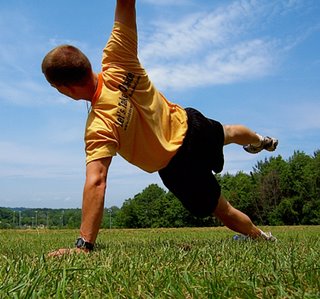 Is climbing the best conditioning for climbing?
 Does a kayaker need to strength train?
What can I do to get prepared for my hiking trip?
Outdoor sports have certainly made it to the map. Despite the extreme classification of some of these sports, you could hardly call them marginal sports anymore. Apart from activities such as base jumping or deep sea diving, outdoor sports are gaining wider popularity and almost becoming mainstream.
As these extreme sports grow, so does the knowledge of how to become better at them. Paddle sports, rock climbing, and hiking are all wonderful activities and can be enjoyed even more by engaging in the proper conditioning.
Questions are often raised on the importance of conditioning for these sports as they are becoming more popular at all levels. One could think that as the extreme sports are often intense and total by nature, add-on conditioning would not be necessary. Now, you cannot get around the fact that the sport itself will not prepare you best for the sport. You cannot become a kayaker by lifting dumbbells, just like you cannot become a climber by doing push-ups. The connection between specific movement patterns and body’s ability to perform can only be produced in the particular movements of the sport itself. Only the sport itself trains the body in right ratio of different motor components. For example; rock climbing involves strength, balance, coordination, flexibility, endurance and power in a specific formula that can only be reached by climbing. However, the human body seems to require a diverse combination of stimulations to become an optimally performing specimen and that is where conditioning comes into the picture. This is supported by the fact that every single successful athlete dedicates a considerable amount of time and effort into programmed sport conditioning.
The focus here is on conditioning that is not performed within the sport activity itself, supplemental conditioning, if you will. As examples of conditioning within the sport, kayakers can condition themselves by paddling sprints of various durations, intensities and recoveries; climbers can perform reactive “dyno” training repeatedly for power and lock-out strength; hikers can focus on the performance specificity by carrying different loads with different speeds.
Supplemental conditioning consists of exercises that are designed to assist in following areas:
- Enhancing the strengths and weeding out the weaknesses of the performance.
- Optimizing body’s overall movement ability and performance capacity in order to enhance adaptation through sport specific training.
- Preventing injuries that might be caused by repetitive movement patterns.
Got chalk?
Tommi
PS: If human beings are perceived as potentials rather than problems, as possessing strengths instead of weaknesses, as unlimited rather that dull and unresponsive, then they thrive and grow to their capabilities. Bob Conklin
Subscribe to:
Comments (Atom)